Local governments across Iowa are facing a rapidly changing clean energy landscape. Projects are arriving faster than many communities can effectively manage, given their limited staff capacity, technical expertise, or regulatory tools. Local governments play a key role in grounding such projects in their community’s priorities. This post highlights a program that equips Iowa communities with the resources they need to plan for and benefit from clean energy projects.
Funded by the US Department of Energy, the Reliable Energy Siting through Technical Engagement and Planning (R-STEP) program in Iowa is providing local communities with the technical knowledge and decision-making support needed for large-scale renewable energy planning, siting, and permitting. R-STEP works directly with Iowa communities to close the knowledge gap and empowers them to make informed, locally grounded decisions about clean energy siting and permitting. The program is led by the Iowa State University Extension & Outreach, with GPI serving as a program partner.
GPI’s efforts with R-STEP build on our siting and planning work in Iowa and the Midwest on utility-scale solar, wind, battery energy storage systems (BESS), and more.
Along with our R-STEP partners, GPI has supported Iowa communities with clean energy siting in several ways:
- Technical assistance: No-cost, hands-on technical assistance helps Iowa communities navigate large-scale clean energy development to ensure that local priorities are addressed, risks are minimized, and new opportunities are realized.
- Workshops: Communities learn about the fundamentals of utility-scale renewable energy siting, permitting, and planning.
- Resources: Through case studies and other resources, communities can learn about innovative projects already underway and see how existing models can apply to their local context.
- Site visits: Local decision makers and officials get to experience and learn about existing renewable energy projects.
What R-STEP technical assistance looks like on the ground
R-STEP is designed to meet communities where they are. Rather than offering one-size-fits-all guidance, GPI works directly with local officials, planners, and stakeholders to understand local priorities, land use constraints, and community concerns.
Here are a few examples of the tailored assistance we’ve provided:
- reviewing draft land use ordinances
- offering recommendations grounded in current siting and planning best practices
- providing technical guidance on regulatory details counties raised as proposals came forward to move through their local processes
In many cases, these requests followed community workshops, when questions surfaced from residents, planning commissions, and elected officials. This often required counties to seek clear, timely technical input from the R-STEP team to respond and determine next steps.
Technical assistance example: BESS siting considerations. Communities in Iowa and across the country have little experience siting BESS. In Buchanan County, Iowa, we presented to the community and the local officials to support their understanding of the operational factors for permitting BESS. Through this workshop, we supported community understanding of the key siting considerations on planning for BESS in rural contexts and how these systems interact with existing land uses. We also discussed the technical aspects of BESS:
- how they operate
- the safety systems in place
- what those features mean in practice
Read our BESS land use fact sheet developed for planners, local officials, and community members to learn about BESS and land use considerations.
We are similarly helping counties implement zoning and permitting tools for solar development that protect or enhance soil health, improve surface and groundwater outcomes, and minimize loss of productive agricultural capacity.
By working alongside communities, GPI has been supporting local governments in Iowa to address practical concerns as they arise. This assistance helps local governments make informed decisions using tools that fit their local framework rather than starting from scratch.
Resources provide examples of local clean energy innovations
As local leaders and communities in Iowa look for practical reference points from neighboring areas developing clean energy projects, GPI developed resources through the R-STEP program on innovative clean energy projects already taking place across the state. Here we highlight two case studies that communities in Iowa and elsewhere can learn from.
Case study example: Grinnell Solar Park. The Grinnell Solar Park is an innovative brownfield redevelopment project that shows how underutilized land can be repurposed into a “brightfield” to produce clean energy while advancing local economic and environmental goals. The case study explored the land use and zoning considerations for solar on brownfield sites, community engagement, and ownership structures that made the project successful. The case study also examined how long-term planning for this project will look for the community.
Read the Grinnell Solar Park brownfield-to-brightfield case study to learn how solar development can align with community revitalization goals.
Case study example: Distributed green ammonia demonstration in Boone, Iowa. In Boone, Iowa, an innovative project is demonstrating distributed green ammonia production (including use of on-site solar), which has the potential to bring many benefits to rural agricultural areas. The project is a collaboration between TalusAg, an agricultural technology subsidiary of Talus Renewables, and Landus, an agricultural cooperative with headquarters in Des Moines. As communities weigh siting and land use considerations, it’s helpful for communities to understand the potential impacts and opportunities from emerging technologies like distributed green ammonia production.
Read the case study to learn how these projects can benefit from a farmer-cooperative business model and from integrating local renewable energy into ammonia production.
The case study is based on an in-depth report, Distributed Green Ammonia: Demonstrating Modular Systems for Sustainable Agriculture, prepared for the Hydrogen Economy Collaborative. The report explores the local and regional economic benefits of distributed green ammonia projects and how they support sustainable agriculture. We also developed a fact sheet for communities to understand the basics of distributed green ammonia production and its benefits.
In-person site visits and dialogue provide peer-learning opportunities
The R-STEP program also includes in-person site visits, which allow local officials to see projects firsthand and engage in on-site conversations about operations and siting impacts.
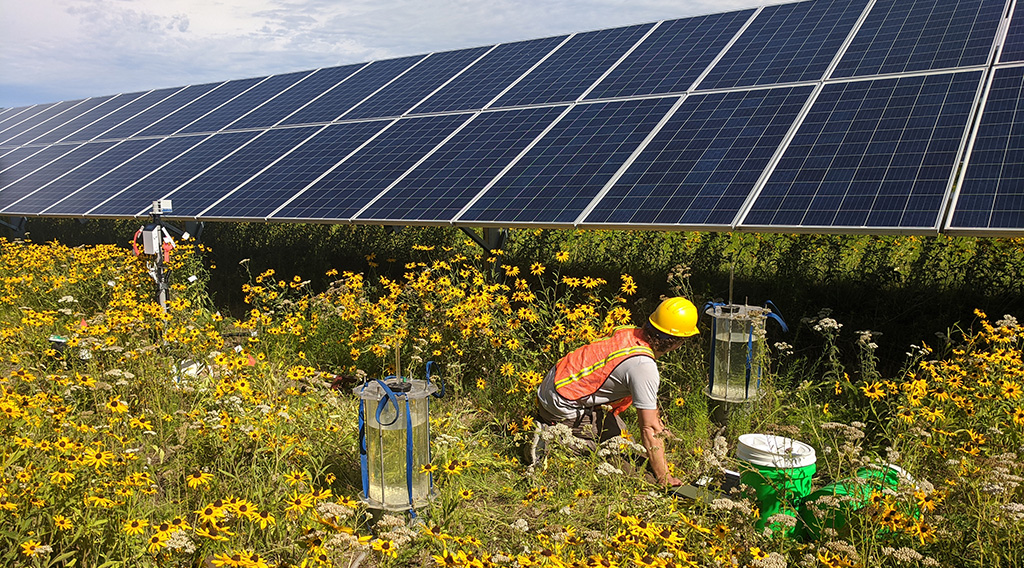
Site visit example: Maple City Solar in Osage, Iowa. This site was part of the PV-SuCCESS project and is demonstrating and documenting the soil health and water quality benefits that can be realized from solar development with the appropriate site selection and design.
There was broad participation from planners, county supervisors, and community residents, who engaged in on-site conversations and posed thoughtful questions. To support these discussions, GPI developed and shared a fact sheet on the surface water quality findings of the PV-SuCCESS research ahead of the visit, ensuring attendees had clear, evidence-based information to guide dialogue.
How this work helps local governments navigate clean energy siting
As communities seek the most affordable energy resources, Iowa’s wind and solar resources are becoming increasingly valuable, and demand is growing. But projects are becoming increasingly complex at a time when local government capacity is stretched thin.
Market conditions are shifting, project timelines are accelerating, and regulatory expectations continue to evolve. Local officials face mounting pressure to understand unfamiliar technologies like battery energy storage and green ammonia, evaluate siting and permitting decisions with confidence, engage residents using clear, fact-based information, and update land use ordinances.
These challenges underscore the need for practical, timely solutions that help communities move from uncertainty to informed decision-making without compromising local priorities. Building on the success of site-specific engagement, there is an opportunity to expand this work across Iowa, the Midwest, and beyond. With additional funding and participation, this effort can scale to reach more regions and deliver the tools decision makers need.
Local governments do not have to navigate clean energy siting alone. GPI provides planning expertise, on-the-ground engagement, and practical resources designed to support informed, locally grounded decisions.
Contact the Great Plains Institute to learn how our programs can support your community.
This material is based upon work supported by the U.S. Department of Energy Office of Critical Minerals and Energy Innovation (CMEI) through the Reliable Energy Siting through Technical Engagement and Planning (R-STEP) program. R-STEP is administered with support from the Partnership Intermediary Agreement (PIA) that the U.S. Department of Energy (DOE) has established with ENERGYWERX.
The views expressed herein do not necessarily represent the views of the U.S. Department of Energy or the United States Government.