In part one of this blog series, we explored the rapid rise in electric bike (e-bike) usage and the public investments fueling this trend. E-bikes can play a crucial role in building a more reliable, affordable, and sustainable transportation system that reduces dependence on personal vehicles, a key part of GPI’s work to decarbonize the transportation sector. State rebate programs and local incentives have made e-bikes more accessible than ever.
Part two examined charging infrastructure and storage needs for privately owned e-bikes.
In part three, we look at the role of bikeshare in driving e-bike usage and the unique charging infrastructure associated with those systems.
E-bike availability in bikeshare programs draws more riders
The electrification of bikeshare systems has led to a boon in ridership around the country, providing users with an option that allows them to reach their destination faster with less effort.
According to the North American Bike and Scootershare Association (NABSA), of the nearly 140 million bikeshare trips taken in North America in 2024, 46 percent were made on e-bikes. This number is even more impressive considering that most bikeshare fleets have substantially more traditional bikes compared to their electric counterparts. For example, in the Citi Bike system, operated by Lyft in New York City and nearby New Jersey communities, e-bikes accounted for 66 percent of rides in 2024, despite making up less than 40 percent of the fleet. When both e-bikes and traditional bikes are available at a Citi Bike station, 71 percent of riders choose an e-bike.
The popularity of e-bikes is evident across Lyft’s portfolio, which includes many of the largest bikeshare systems in the country. Notably, Capital Bikeshare in Washington, DC, and POGOH Bikeshare in Pittsburgh saw ridership on e-bikes increase by 143 percent and 138 percent, respectively, from 2023 to 2024.
The NABSA graphic below highlights the year-over-year increase in electrified bikeshare trips since 2019.
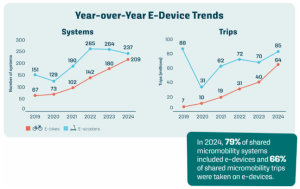
Source: North American Bike and Scootershare Association (NABSA).
The increasing ridership of e-bikes within bikeshare programs is prompting operators across the country to assess how best to keep e-bikes charged within the fleet. There are two primary methods by which operators currently electrify their bikeshare fleets, each with its pros and cons.
E-bike battery swapping
According to NABSA’s 2024 survey of bikeshare operators, battery swapping is the current industry standard for keeping bikes charged. Operations staff will bring fully charged batteries directly to the bikes themselves, sometimes accessing strategically placed charging cabinets, and swap the depleted battery with a new one.
The biggest downside to battery swapping is the enormous amount of time it takes operations staff to identify, locate, and replace depleted batteries, resulting in huge operational costs that did not previously exist with standard bikeshare bikes. For dockless bikeshare systems, where bikes are free-floating and not required to be returned to a specific station, battery swapping is the only available strategy for keeping bikes charged.
In-dock e-bike charging
While battery swapping currently dominates how systems recharge their fleet, the future for station-based bikeshare systems looks to be in-dock charging.
In-dock charging is exactly what the name suggests—when a bike is returned to a designated docking station, it begins to automatically charge through a connection in the dock itself. This substantially reduces the operational capacity needed to keep fleets charged. Docks capable of charging bikes are powered by a direct connection to the grid, utilization of solar panels, or a combination of both.
Directly connecting stations to the electrical grid is the most common way to keep charging docks running, allowing for a reliable and powerful connection. However, this approach can sometimes require expensive underground connections, collaboration with the local utility company, and potential hurdles to station placement depending on connection access.
Using solar for station electrification allows systems to tap into clean, cheap energy and locate stations regardless of their proximity to a power source. However, solar power can be unreliable and dependent on battery storage capacity, while the equipment can be expensive to install. As of February 2025, the cost of a D4 Solar Station from Skyhook Solar, one of the industry leaders, was $34,500.
Notably, systems do not need to electrify every station in their geography to keep bikes charged, as industry experts estimate that electrifying just 20 percent of stations in high-traffic areas is enough to keep the system electrified. A combination of grid and solar power, depending on each station’s requirements, may allow systems to maximize the benefits of each approach.
Supporting the growth of e-bikes
Whether privately owned or part of a citywide bikeshare network, e-bikes provide riders in every type of community with access to affordable and sustainable transportation.
GPI believes that supporting the growth of e-bikes and all forms of active transportation is necessary to help foster healthier lifestyles, reduce congestion, and create more connected neighborhoods while contributing to our climate goals.
Reach out to GPI at info_transportat[email protected] to learn more about how your community can support and prepare for the growing shift toward electric mobility, from bikes to cars.