A new electricity rate in the Midwest is opening a path to save money for industry, lower costs for other customers on the grid, and make better use of existing clean energy. The new rate, or tariff, enables industrial customers to electrify by using thermal storage to capture only the cleanest, lowest-cost hours of electricity via wholesale market pricing. When combined with time-varying and location-based electricity rates, industrial facilities can secure cost-effective clean energy when supply is abundant and use that energy around the clock to produce steam for industrial processes.
What you need to know
- Several barriers currently prevent industrial customers from electrifying process heating. The cost difference between using gas and electricity (“the spark gap”) is one major barrier for customers. Utilities and regulators may also need to consider risks of increasing strain on existing grid assets and potential cost impacts on other ratepayers.
- Otter Tail Power has developed an innovative rate solution that addresses these challenges by allowing thermal storage projects to minimize electricity costs through wholesale market pricing. Known as Thermal Market Energy Pricing (TMEP), this voluntary tariff uses only the cheapest hours of clean electricity to charge thermal batteries, which store energy as heat. The thermal batteries then deliver affordable, on-demand, low-carbon steam for industrial applications, benefiting the electric grid by using otherwise curtailed energy.
- State energy regulators in Minnesota, North Dakota, and South Dakota have approved the TMEP across Otter Tail Power’s service territory, charting the way for other utilities and jurisdictions to consider a similar approach.
What’s behind the Thermal Market Energy Pricing tariff
In 2025, energy regulators in three Midwestern states approved a new Otter Tail Power tariff that will allow industrial customers to access low-cost, low-carbon steam for industrial heating through partnerships with thermal energy storage providers. The voluntary TMEP tariff was first approved by the South Dakota Public Utilities Commission in July 2025 and has since been approved by the utility commissions in both Minnesota and North Dakota.
Currently, only one customer receives service under the tariff—the Big Stone Energy Storage Project in Big Stone City, South Dakota. The project exemplifies how this type of tariff can benefit industrial facilities seeking to reduce operating costs and/or emissions, while also helping electric utilities expand their customer base, maximize use of existing assets, and manage load. In this blog, we provide a case study of this project, followed by comments on its significance and broader applicability.
South Dakota case study
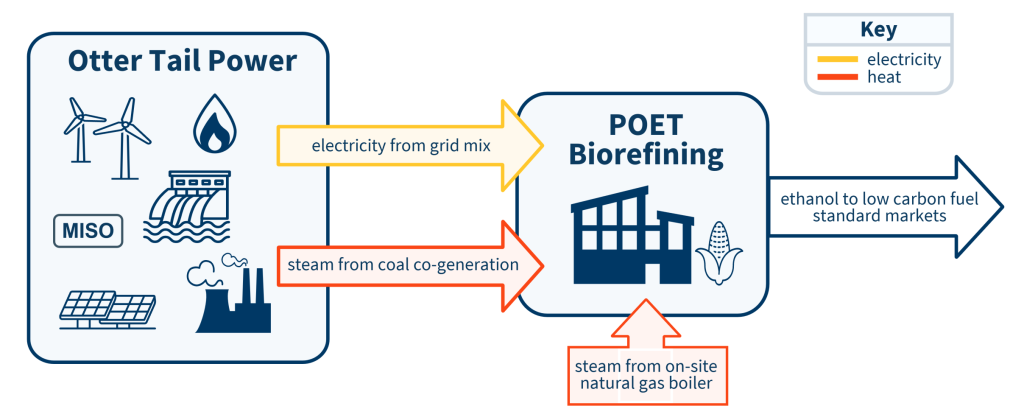
POET Biorefining, a long-standing Otter Tail Power customer, is an ethanol refinery located in Big Stone City. POET requires reliable supplies of electricity and steam to operate. Before the TMEP tariff was available, POET purchased electricity from Otter Tail Power and received steam from two sources: a nearby coal-fired power plant operated by Otter Tail Power that cogenerates electricity and steam, and POET’s own on-site natural gas boiler. This pre-TMEP arrangement is illustrated in figure 1.
Figure 1: POET Biorefining steam and electricity supply, before Thermal Market Energy Pricing (TMEP)
Source: Graphic produced by GPI using information available in South Dakota Public Utilities Commission Docket Nos. EL25-015, EL25-016, and EL25-017.
Big Stone Power Plant, the coal-fired power plant, was POET’s primary source of steam. However, the plant has operated less in recent years because availability of cheaper local wind has reduced the plant’s economic dispatch. Therefore, Otter Tail Power frequently runs the plant at reduced output or brings it offline altogether. POET has historically supplemented this steam supply with the on-site gas boiler.
Big Stone Energy Storage Project
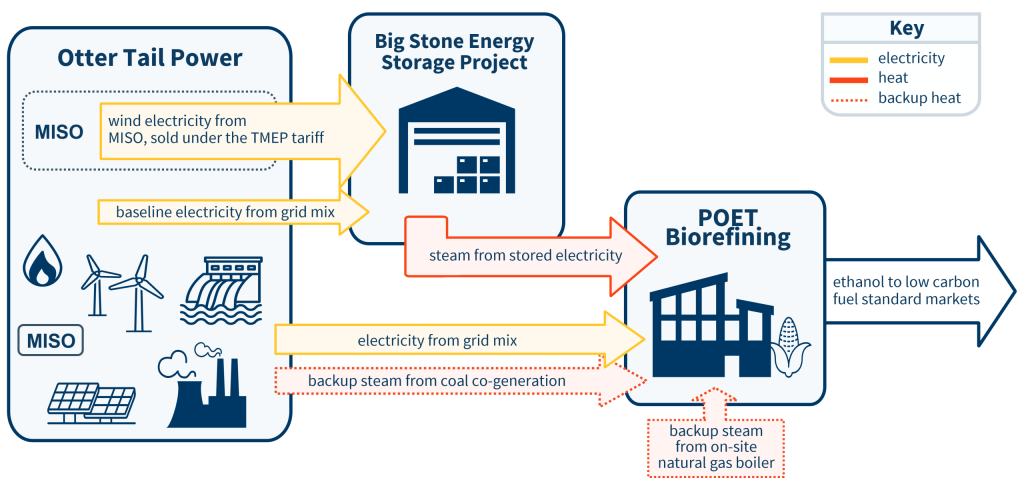
To provide an alternative, low-cost, reliable steam supply, thermal battery manufacturer Antora constructed the Big Stone Energy Storage Project (BSESP). Operating as a third-party entity, the BSESP is a new 5 gigawatt-hour thermal storage facility located adjacent to POET’s facility in Otter Tail Power’s service territory. The facility charges at off-peak times when local generation exceeds supply, mostly due to curtailed wind. Its sole purpose is to supply reliable, low-cost, low-carbon steam to POET (figure 2).
BSESP purchases electricity from Otter Tail Power under two pricing and delivery arrangements. The first is a baseline level of firm electricity used to serve BSESP’s balance-of-plant loads (i.e., all electrical demand except the thermal batteries) via the utility’s standard industrial tariff.
The second is the TMEP tariff, which supplements this firm supply with a market-based rate for charging the thermal storage system. Under the resulting arrangement, BSESP works with Otter Tail Power to purchase electricity from MISO, the regional grid operator, at hourly rates. Electricity is delivered under a location-based rate, which is determined at the point of interconnection for BSESP. The tariff requires BSESP to only draw power from the MISO grid when specified, nearby clean generation resources (wind, in this case) are actively generating. Thus, customer pricing is determined by the availability of local energy in an area where the grid typically experiences high congestion and curtailment.
BSESP also purchases distribution and transmission service from Otter Tail Power, including payments to fully cover the cost of connecting the thermal energy storage facility to the grid.
When BSESP receives electricity, it converts it to heat stored in highly insulated blocks of solid carbon. The carbon holds significant amounts of energy for multi-day durations and can deliver heat for extended periods without recharging. The long-duration storage allows BSESP to manage the risk of market-based pricing, purchasing electricity during periods of low cost. These low-cost electricity periods often occur because more generation is available than other customers on the grid can use at that time.
BSESP discharges low-carbon steam to POET around the clock, with pricing established through a private contract. The biorefinery also retains a connection to the Big Stone Power Plant and gas distribution infrastructure for backup steam supply.
This unique new arrangement is illustrated below in figure 2.
Figure 2: POET Biorefining steam and electricity supply, with Thermal Market Energy Pricing (TMEP)
Source: Graphic produced by GPI using information available in South Dakota Public Utilities Commission Docket Nos. EL25-015, EL25-016, and EL25-017.
Note: The thermal storage tariff is only available to facilities that use electricity for thermal storage. In this case, BSESP is the only eligible facility. POET Biorefining continues to purchase electricity from Otter Tail Power under its general service rate and does not receive service under the TMEP tariff.
Benefits of the new arrangement
In this example, the TMEP tariff has enabled project partners to replace unreliable steam with a steady and more cost-effective supply, reduce congestion and curtailment for local generation assets, and reduce the carbon intensity of an industrial product. The combined impact of reduced emissions and affordable electricity is expected to increase POET Biorefining’s competitiveness in nationwide ethanol markets, though exact savings and emissions reductions are not publicly available.
From a systemwide perspective, the TMEP tariff enables Otter Tail Power to sell more electricity without adding to peak load or increasing costs for other ratepayers, because it includes safeguards that prevent other customers from subsidizing the infrastructure upgrades necessary to serve BSESP. In addition, BSESP serves as a local sink for curtailed renewable electricity that might otherwise have required costly transmission upgrades to reach customers. By improving utilization of Otter Tail Power’s existing transmission and generation infrastructure, infrastructure costs are now spread over a greater volume of electricity sales, putting downward pressure on rates for other ratepayers.
Success factors and broader applicability
Several factors led to the success of the new partnership in Big Stone City:
- Favorable economics to provide low-cost, reliable steam using thermal storage, including proximity of BSESP and POET to low-cost local electricity.
- Opportunity for a reliable and clean steam supply for POET.
- Incentive for POET to procure low-carbon steam to compete in low carbon fuel standard markets and qualify for §45Z federal tax credits for domestically produced clean transportation fuels.
- Collaborative local partners.
The TMEP tariff has the potential to benefit other industrial customers in Otter Tail Power’s service territory that may be in a similar situation, and it is an example that other utilities may follow.
Otter Tail Power has stated that the TMEP tariff is intended to apply to the diverse range of facilities and circumstances comprising the industrial sector, including any industrial facility that requires process heat. This could include other low- to medium-temperature industries such as food and beverage, pulp and paper, and chemical production. There have also been requests for other utilities to propose similar tariffs.
Future participants in the TMEP tariff would likely be similar to the Big Stone Energy Storage Project: thermal storage facilities seeking to store electricity as heat and deliver steam to an industrial partner through a private contract. The tariff enables these facilities to purchase clean electricity only when it is cheapest, thereby allowing them to sell cost-effective steam to industrial customers. The tariff is voluntary and is not limited to a specific type of storage technology. To receive service under this tariff, these facilities must meet a set of specific requirements:
- Sized at 25 MW or greater.
- Operating with a load factor below 50 percent.
- Contractually and operationally tied to a “specific nearby wind and/or solar generation resource.”
- Willing to be registered as a load-modifying resource in MISO (meaning they can ramp down quickly to respond to grid conditions).
Conclusion
The TMEP tariff is a cost-effective energy solution that provides economic and grid benefits to industrial customers and other ratepayers while also reducing process heat emissions. This is a win-win for states, promoting industrial investment and job growth by maximizing the use of existing infrastructure and minimizing costs to other ratepayers.
Interested in learning more about the Big Stone project, the TMEP tariff, or industrial heating in the Midwest? Email our Energy Systems team.