Autonomous vehicle (AV) technology is increasingly making headlines, fueling debates about its benefits and drawbacks. As it stands, there is a lack of consensus around the technology’s potential, as many factors that will influence the long-term impact of AVs remain unknown. This can place local governments in a difficult position, as AV deployment may have wide-ranging implications for how people and goods move through communities. Planning for AVs will require recognizing that many factors remain uncertain and understanding what levers local governments have at their disposal.
While it is challenging to predict the exact impacts of AVs, understanding what outcomes are possible is a necessary first step in determining how AVs could support or hinder local goals.
Recognizing AVs’ potential to disrupt existing systems and increase carbon emissions from transportation, GPI is committed to supporting local governments and communities as they begin planning for this technology. We recently produced a resource to help local governments understand the levers they have to shape this technology’s deployment: Aligning Autonomous Vehicles with Sustainability Goals: Local Government Playbook.
This post provides local governments and communities with a starting point for thinking about and planning for AVs and their potential impacts.
Autonomous vehicle technology and regulatory landscape
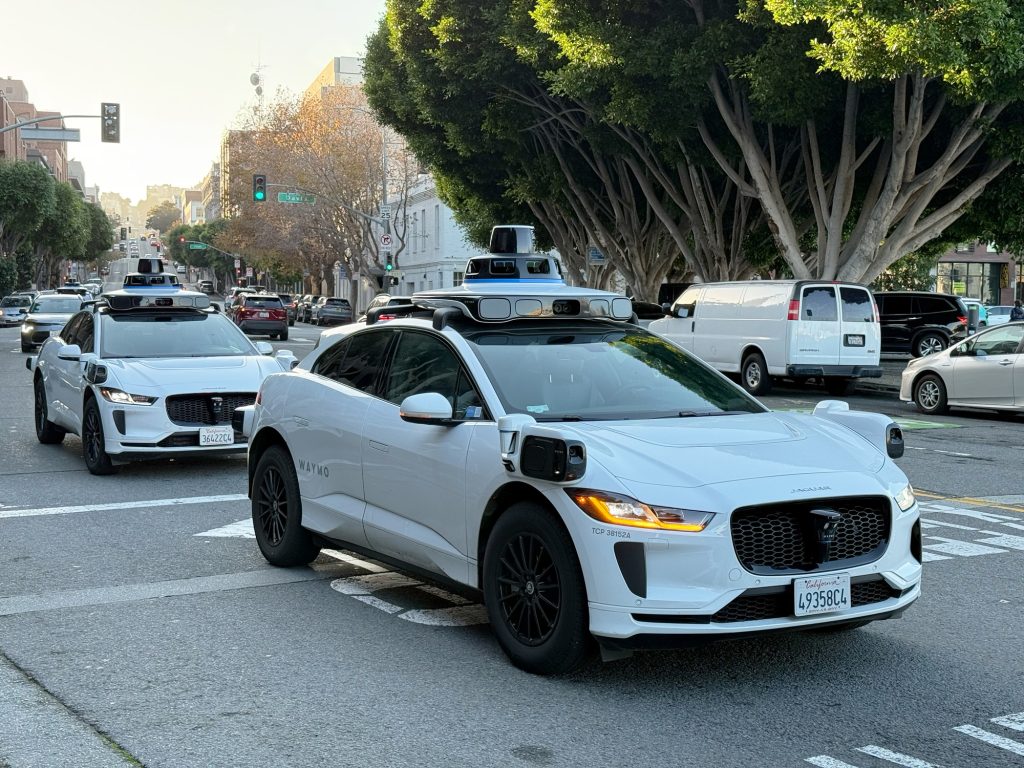
While the arrival of autonomous mobility has long been anticipated, AVs have begun moving beyond limited deployment into paid, publicly available operations.
The Society of Automotive Engineers (SAE) levels of driving automation have become the industry standard for categorizing autonomous driving technologies. Many modern vehicles are equipped with driver support features (SAE Levels 0 through 2), and commercial AV operations are using vehicles equipped with SAE Level 3 and Level 4 features. At this point in time, there are no real-world examples of Level 5 AVs on the road.
Figure 1. SAE’s Levels of Driving Automation
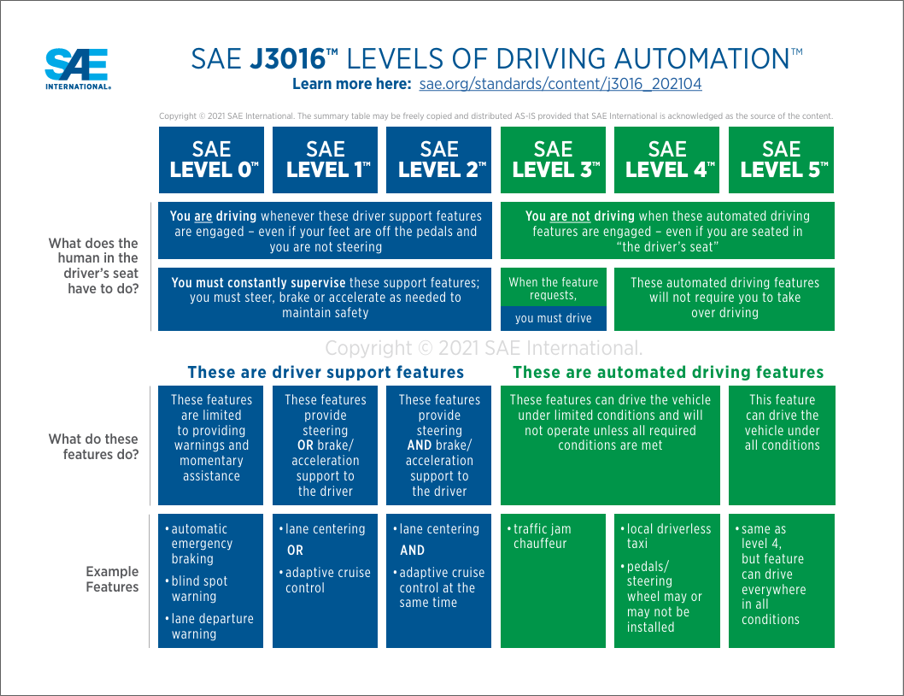
Source: “SAE Levels of Driving Automation™ Refined for Clarity and International Audience,” SAE International, May 2, 2021. (click link for full size)
Even as the technology advances, real barriers remain. AVs are still challenged by adverse weather that interferes with onboard cameras and sensors, as well as unusual conditions, like construction zones and poorly marked intersections. There are also outstanding questions in the industry about the best combination of hardware and software for AVs.
Despite this, companies are expanding rapidly into a diverse range of cities across the country. With major players in the commercial AV rideshare industry like Waymo securing significant financial backing, expanding to over 14 US cities, and logging hundreds of thousands of weekly passenger trips, the question is no longer whether automated driving is technically possible. Instead, the focus is shifting to what AV deployment will look like in the real world, how quickly it will expand, and what its impacts will be on local communities.
Importantly, this rapid rollout is occurring without a stable regulatory environment. There are no comprehensive federal standards specific to AVs, and 43 states have adopted AV-related laws, many of which preempt local authority to directly regulate these vehicles.
As the policy and regulatory landscape matures, it will be crucial for local governments to remain diligent in understanding their existing authority to regulate this technology and its impacts.
Potential impacts of autonomous vehicles on communities
Predictions of the impacts of AV deployment vary widely depending on methodology, assumptions, and data used. Effective planning for AVs will require understanding potential impacts, determining which policy measures may yield desired outcomes, and recognizing which factors remain outside of local control.
One key factor that will determine how AVs impact communities is whether these vehicles are deployed as fleets or are privately owned by individuals. Research predicts that privately owned AVs would be far more disruptive to local systems and increase metrics like vehicle miles traveled (VMT) and emissions compared to scenarios with shared AVs.
GPI’s approach centers on helping local governments prioritize vehicles that are connected, automated, shared, and electric (CASE) when AVs are appropriate, a framework we explore further in our playbook for local governments.
The following section identifies transportation and community considerations related to AVs and presents potential outcomes across core metrics for assessing AV impacts.
Vehicle miles traveled
Most models agree that AV deployment will increase driving and VMT. This is especially important as VMT directly impacts other metrics like emissions, congestion, and roadway safety. In some scenarios, it is predicted that AVs could lead to significant growth in VMT, potentially increasing household driving by up to 60 percent. On the other hand, assuming shared rides and integration with transit, other models predict a more moderate 14 percent VMT increase.
How AV adoption impacts VMT will depend on whether AVs are personally owned or shared, as well as on policy choices, such as how roadway use is priced and operating agreements with AV service providers.
Greenhouse gas emissions
AVs could significantly increase or decrease greenhouse gas emissions. The impact will depend on travel patterns, fuel type, local grid emissions, and related policy choices. Importantly, much of the existing body of research shows that even if AVs produce fewer emissions per mile than cars on the road today, these benefits could be offset if AVs simultaneously increase driving overall. Under best-case scenario models, it is predicted that AVs could reduce emissions by up to 87 percent, compared to a 72 percent increase in emissions under other scenarios.
Traffic congestion
AVs could improve traffic flow and efficiency if widespread adoption occurs, especially if paired with technology that allows for seamless communication and information sharing between vehicles. However, AVs could also worsen traffic congestion, potentially increasing delays by upward of 60 percent if empty AVs circulate to avoid parking and disrupt traffic flow when dropping off and picking up passengers. Actual impacts will depend on market penetration and on how human drivers and AVs interact in mixed traffic, as well as on policy choices like restrictions on empty cruising and roadway pricing initiatives.
Roadway safety
Both industry players and independent third parties have now assessed real-world data that supports the claim that AVs are, or can be, safer than human drivers. For example, a study from the Insurance Institute for Highway Safety found that Waymo Level 4 AVs were involved in 68 percent fewer crashes than human drivers, based on police-reportable crashes. This safety potential should not be discounted, as traffic crashes in the US cause over 36,000 deaths, millions of injuries, and billions of dollars in damage annually. However, the data being used to make these safety claims is limited, collected from just a handful of markets and operators under very specific conditions.
While the existing data is encouraging, researchers from RAND estimate that billions of AV miles would need to be tracked and assessed to be able to statistically prove that AVs are safer than human drivers. Additionally, while AVs have the potential to be safer than a human driver, this does not mean every AV will be safer. This is due to real differences in hardware, software, how these vehicles are trained, and the risk thresholds programmed into AVs, which will vary to some degree between AV service providers without standardized regulations.
The curb and public right-of-way
The widespread adoption of AVs at scale will likely disrupt and could potentially crowd and overwhelm curb space and the public right-of-way as more travelers compete for limited space. With real-world curb audits already showing that unmanaged curbside loading often results in double parking and congestion delays, the increase in demand for curb space from AVs is only expected to exacerbate the issue without proactive planning. This disruption is already impacting other modes like biking, walking, and rolling, by blocking curb cuts, bike lanes, and active transportation flow.
However, the adoption of AVs could also lead to rethinking how the curb is managed, and how space within the public right-of-way is allocated. If AVs increase traffic efficiency and reduce the demand for parking, as some predict, excess roadway and on-street parking space could be repurposed for enhanced bicycle and pedestrian infrastructure, transit stops, and dynamic loading and pickup/drop-off zones.
Land use and urban form
Under a best-case scenario, shared AVs could reduce demand for parking by between 90 and 95 percent, since these vehicles would be in constant use rather than needing to park, allowing surface lots to be redeveloped in alignment with local goals and aspirations. However, less optimistic predictions highlight the potential for urban sprawl if AVs make long car trips much easier, with some models projecting that metropolitan areas could grow by upward of 60 percent if AVs are privately owned. Addressing these potential impacts will require forward-thinking land-use policies to encourage development that supports community goals.
Transportation equity and accessibility
AVs have the potential to provide mobility benefits and access to opportunities for community members who can’t drive, have mobility limitations, or are otherwise underserved by the existing transportation system. Nationally, AV services could provide independent travel options for the approximately 36 percent of Americans who can’t rely on a personal vehicle for daily travel needs, or the roughly 18.6 million Americans with disabilities that impact mobility. And while AVs are often discussed as an urban technology, they could provide major benefits to rural communities with aging populations that lack transit options.
At the same time, if AVs are primarily privately owned or deployed without careful planning, they could make existing inequities within transportation systems worse, while the benefits of this technology accrue to affluent community members who can afford the technology. Planning for the future deployment of this technology will require communities and local governments to center equity and accessibility in the development of policies and regulations.
The future of AVs
The impact of AV deployment is not predetermined. Whether this technology helps build safer, more accessible communities or contributes to congestion, sprawl, and emissions will depend on how this technology is regulated. Rather than waiting until AVs are at the front door, local leaders can establish community-led goals now and use available tools to help ensure automated technology is deployed in alignment with local goals.
To help in this effort, GPI will continue to examine AVs and what this technology may mean for communities in future posts. Potential topics include how AVs may impact existing transportation systems, the use cases for AVs in rural communities, and the potential impacts of autonomous sidewalk robots and delivery drones.
In the meantime, check out our recent resource for local governments on aligning AVs with sustainability goals.
Contact us if you would like to begin planning for autonomous vehicle technology in your community.