


 MILWAUKEE – The Midwest Energy Research Consortium (M-WERC) and the Great Plains Institute (GPI) today announced new recommendations to accelerate innovation and technology deployment in the rapidly-evolving utility sector to fuel economic development, drive clean energy job growth, and reduce customer costs in Wisconsin. Continue reading »
The Better Energy Community is constantly growing and evolving.
Read about our latest projects and successes on our blog.
Transportation Electrification Collaborative Sends Economic Recovery Recommendations to Congress
July 24, 2020 in Transportation & Fuels Author: Brendan Jordan
Members of the Midcontinent Transportation Electrification Collaborative (MTEC) this week sent a letter to Congressional leaders outlining a suite of recommendations for how clean transportation investments can support economic recovery, job creation, and provide environmental and public health benefits. Facilitated by GPI, MTEC works to increase electric vehicle (EV) use, build infrastructure to support EV travel, decarbonize the transportation sector, and improve air quality and electric system efficiency. MTEC is composed of representatives from state government, electric utilities and cooperatives, charging companies, and environmental organizations. You can read the collaborative’s full letter below.
July 23, 2020
| The Honorable Mitch McConnell Majority Leader United States Senate Washington, D.C. 20510 |
The Honorable Chuck Schumer Minority Leader United States Senate Washington, D.C. 20510 |
| The Honorable Nancy Pelosi Speaker U.S. House of Representatives Washington, D.C. 20510 |
The Honorable Kevin McCarthy Minority Leader U.S. House of Representatives Washington, D.C. 20510 |
Regional Industrial Initiative Releases Federal Policy Recommendations for U.S. Economic Recovery and Long-Term Emissions Reductions in American Industry
July 23, 2020 in Carbon Management, News & Press Authors: Brad Crabtree, Jill Syvrud, Patrice Lahlum
(Washington, D.C.) – The Industrial Innovation Initiative, an ambitious coalition of key industrial and power companies, environmental organizations, and state officials from Midwestern and Gulf Coast states focused on decarbonization solutions for the region’s most important industrial sectors, submitted recommendations to Congress today outlining measures for consideration in COVID-19-related federal economic recovery legislation. Continue reading »
Solar, with Benefits! (Or, the Co-Benefits Approach to Solar Development)
July 6, 2020 in Renewable Energy Author: Brian Ross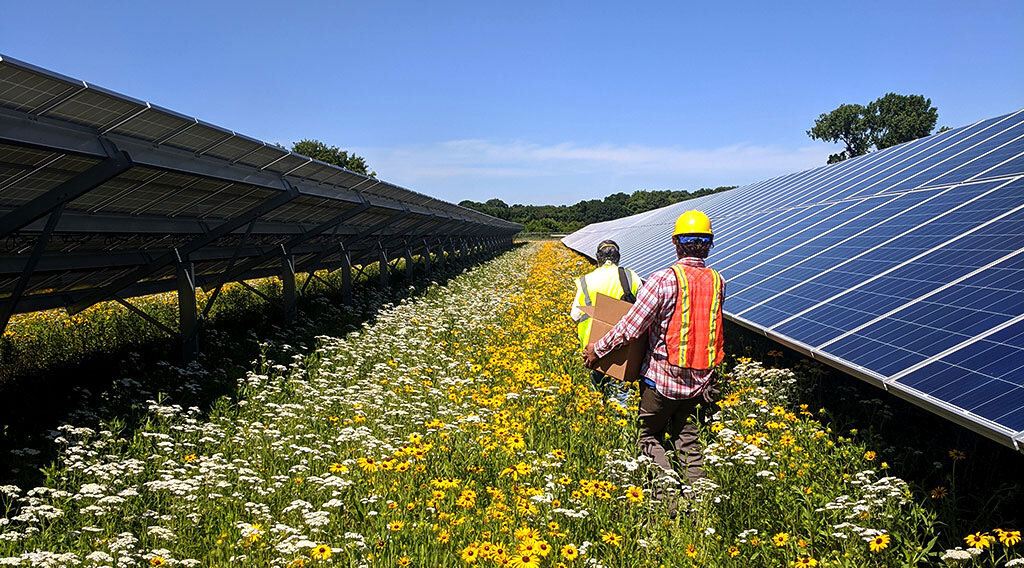 Solar energy is not only important to reaching a zero-carbon energy system—solar projects can, with appropriate siting and design, also deliver many benefits to local communities where projects are sited. Deploying the level of solar needed to decarbonize our economy will require addressing siting and regulatory processes which are increasingly a barrier to solar project development. The Great Plains Institute is fostering a new paradigm in the deployment of community- and utility-scale solar development; what we call the co-benefits approach to solar. We’re working with state, regional, and national partners to identify how energy development can both help solve the climate crisis and deliver local benefits to the host community. Continue reading »
 The Great Plains Institute recently hosted “Center Out: A Strategy for Climate Success,” a virtual event featuring President & CEO Rolf Nordstrom and a panel of our energy experts discussing how Midwestern states can lead the way in the post-COVID energy landscape. Continue reading »
GPI Launches Survey on Standby Rates Best Practices for Combined Heat and Power
July 1, 2020 in Energy Systems Author: Jamie Scripps The Great Plains Institute is launching a survey requesting feedback on best practices in standby rates for combined heat and power (CHP). According to Lola Schoenrich, vice president of communities at GPI, “Best practices for standby rates have begun to emerge, but we need to further define and standardize these practices. The purpose of this survey is to begin to critically examine these emerging recommended practices with interested stakeholders such as regulators, potential CHP users, developers, technical experts, and utilities.” Continue reading »
New Analysis: Carbon Capture and Storage Infrastructure for Midcentury Decarbonization
June 30, 2020 in Carbon Management, News & Press, Reports & Whitepapers Author: Dane McFarlane
 The Great Plains Institute (GPI) is excited to announce the final results of more than two years of research and modeling on carbon capture and storage opportunities throughout the US. The white paper, Transport Infrastructure for Carbon Capture and Storage: Regional Infrastructure for Midcentury Decarbonization, summarizes our findings and details our analytical approach. The analysis identifies near-term capture and storage opportunities, then designs and plans the regional transport infrastructure required to maximize CO2 abatement while minimizing cost and land use impact. Continue reading »
Announcing Powering Ahead with Vehicle Electrification (PAVE)
June 30, 2020 in Communities, Transportation & Fuels Author: Diana McKeown
Powering Ahead with Vehicle Electrification (PAVE) will provide resources and technical assistance to sixteen municipal utilities across Minnesota to educate and engage customers to meet their community’s electric vehicle (EV) adoption goals.
Together: Scaling Local Action for the Greatest Climate Impact
June 26, 2020 in Carbon Management Author: Morgan Zehner This blog is one in a series that celebrates the variety of professionals who have been touched by the Great Plains Institute (GPI). Together—GPI’s spring fundraising campaign—showcases people who work in multiple industries and have various constituents and customers, but all play an important role in helping America transform its energy system.
NAME: Larry Kraft
AFFILIATION: City of St. Louis Park, Minnesota
TITLE: At Large Council Member Continue reading »
How Repowering Aging Renewables in the Midcontinent Impacts Carbon Emissions
June 18, 2020 in Energy Systems Authors: Jessi Wyatt, Maggie Kristian Many wind and solar energy projects in the Midcontinent will face the decision to repower or decommission as they reach the end of their useful lifespan between 2020-2050. These decisions will impact the energy mix of the existing electricity system—and its carbon emissions. We analyzed potential scenarios for repowering the Midcontinent’s wind and solar energy fleet, sharing potential implications for the region’s electricity system and carbon emissions. These scenarios show why repowering aging renewables in the Midcontinent is important to continue reducing the region’s electricity emissions. Continue reading »

Our Newsletter
Sign Up for Better Energy Community News
Sign up to receive the latest news and announcements from the Great Plains Institute.
