


 Great Plains Institute Vice President for Carbon Management Brad Crabtree submitted written testimony to the Senate Environment and Public Works Committee to inform a Wyoming field hearing this week examining “Energy and Environmental Innovation: Wyoming’s Leadership in Using and Storing Carbon Dioxide Emissions.” Continue reading »
The Better Energy Community is constantly growing and evolving.
Read about our latest projects and successes on our blog.
Kehinde Bello Shares Her Experience as a GreenStep Cities Intern
August 18, 2020 in Communities Author: Kehinde Bello
My name is Kehinde Bello and this past spring I interned with the Great Plains Institute, where I assisted with GPI’s work as a partner of the Minnesota GreenStep Cities program. Through this internship, I not only made connections with mentors and colleagues, but I also learned how collaborative community engagement can lead to a more significant impact. Continue reading »
Solar and Wind in Michigan: A Local Government Guide for Siting Utility-Scale Projects
August 14, 2020 in Communities, Energy Systems Authors: Jenna Greene, Jessi Wyatt The Great Plains Institute is engaging local governments across the Upper Midwest on long-term planning for renewable energy. As part of this effort, we developed a guide to provide communities in Michigan with an overview of long-term utility- and community-scale solar and wind development—systems sized one megawatt (MW) or greater. Continue reading »
Solar Plus: How Solar-Integrated Agriculture Could Reduce Barriers to Large-Scale Solar Deployment
August 12, 2020 in Renewable Energy Author: Brian Ross
The United States could see 300 gigawatts of large-scale solar deployment in the next decade, with 150–200 gigawatts concentrated mainly in the Midwest where existing land use is often tied to agriculture. The significant land use and siting barriers to this large-scale solar deployment are daunting and warrant re-thinking the role of solar in agricultural economies. By moving toward beneficial solar-integrated agriculture or co-location of solar and agriculture—vs. solar as a single-use development—we can capture the benefits of both while reducing potential conflict. Continue reading »
Community Partnerships Accelerate Electric Vehicle Charging in Minnesota
August 11, 2020 in Communities, Transportation & Fuels Author: Diana McKeown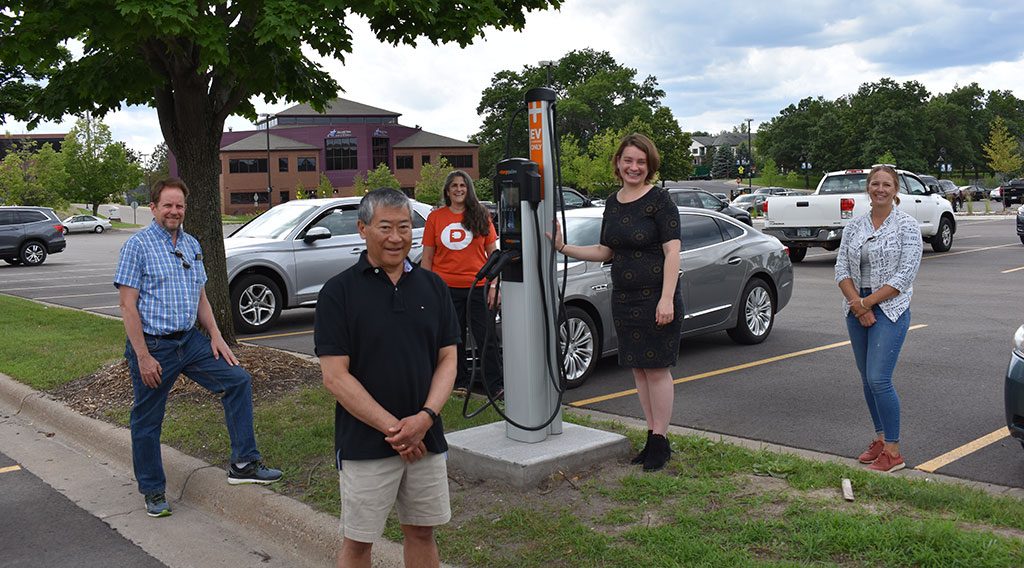 Last summer, the Great Plains Institute facilitated a project to accelerate the adoption of electric vehicles (EVs) through public EV charging installations in the Minnesota cities of Shoreview and White Bear Lake in partnership with employees from Cummins Inc. Both communities host Cummins facilities and were excited to collaborate on EV chargers as part of their work to advance sustainability. Cummins was looking for a project to advance sustainability in the communities where they have facilities and where many of their local employees live. The EV project demonstrated the value of partnerships in making progress on community sustainability efforts. Continue reading »
Webinar: Preparing to Plan for Climate Change—What Tools Do We Need for Local Governments?
August 10, 2020 in Communities Author: Jessi Wyatt Results from a national survey of planning practitioners provide insight into the types of tools and templates that local governments need to see progress on climate action. The Great Plains Institute collaborated with American Planning Association (APA) divisions on an in-depth survey that identified opportunities to support cities on climate action—from climate goals to implementation. We recently presented the survey results during two APA webinars with our association colleagues (video recording and slides available below). Continue reading »
Webinar: Analysis of Transport Infrastructure Shows Near-Term Carbon Capture and Storage Potential
July 30, 2020 in Carbon Management Author: Lauren SchultzOn July 20, the Great Plains Institute and Regional Carbon Capture Deployment Initiative hosted a webinar on the white paper, Transport Infrastructure for Carbon Capture and Storage: Regional Infrastructure for Midcentury Decarbonization. This report highlights the scale and design of carbon dioxide (CO2) capture and transport infrastructure needed to meet US midcentury climate goals in the industrial and power sectors. The two-year modeling effort identified 418 industrial and power facilities throughout the US that can feasibly capture 360 million metric tons of CO2 per year at a relatively low cost. Continue reading »
Stakeholder Group Announces Recommendations for Wisconsin’s Clean Energy Future
July 24, 2020 in Energy Systems Author: Trevor Drake MILWAUKEE – The Midwest Energy Research Consortium (M-WERC) and the Great Plains Institute (GPI) today announced new recommendations to accelerate innovation and technology deployment in the rapidly-evolving utility sector to fuel economic development, drive clean energy job growth, and reduce customer costs in Wisconsin. Continue reading »
Transportation Electrification Collaborative Sends Economic Recovery Recommendations to Congress
July 24, 2020 in Transportation & Fuels Author: Brendan Jordan
Members of the Midcontinent Transportation Electrification Collaborative (MTEC) this week sent a letter to Congressional leaders outlining a suite of recommendations for how clean transportation investments can support economic recovery, job creation, and provide environmental and public health benefits. Facilitated by GPI, MTEC works to increase electric vehicle (EV) use, build infrastructure to support EV travel, decarbonize the transportation sector, and improve air quality and electric system efficiency. MTEC is composed of representatives from state government, electric utilities and cooperatives, charging companies, and environmental organizations. You can read the collaborative’s full letter below.
July 23, 2020
| The Honorable Mitch McConnell Majority Leader United States Senate Washington, D.C. 20510 |
The Honorable Chuck Schumer Minority Leader United States Senate Washington, D.C. 20510 |
| The Honorable Nancy Pelosi Speaker U.S. House of Representatives Washington, D.C. 20510 |
The Honorable Kevin McCarthy Minority Leader U.S. House of Representatives Washington, D.C. 20510 |
Regional Industrial Initiative Releases Federal Policy Recommendations for U.S. Economic Recovery and Long-Term Emissions Reductions in American Industry
July 23, 2020 in Carbon Management, News & Press Authors: Brad Crabtree, Jill Syvrud, Patrice Lahlum
(Washington, D.C.) – The Industrial Innovation Initiative, an ambitious coalition of key industrial and power companies, environmental organizations, and state officials from Midwestern and Gulf Coast states focused on decarbonization solutions for the region’s most important industrial sectors, submitted recommendations to Congress today outlining measures for consideration in COVID-19-related federal economic recovery legislation. Continue reading »

Our Newsletter
Sign Up for Better Energy Community News
Sign up to receive the latest news and announcements from the Great Plains Institute.
